Rochester, MN · Garage Door Service
Byron homes date mostly to 2000, newer than the Rochester-area median. That means different failure points - here's what actually breaks and how the fix works.
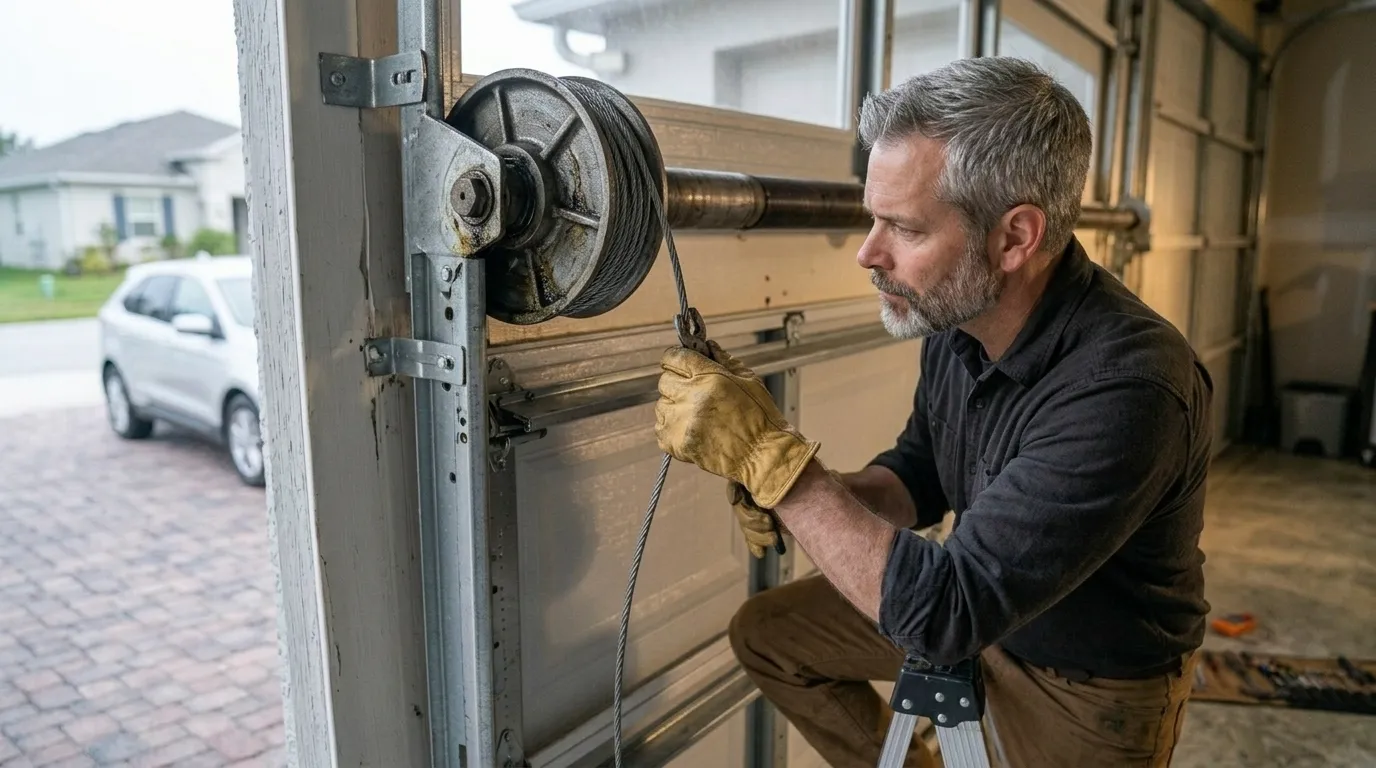
The call we get most out of Byron isn't a snapped one-piece door or ancient side-mounted hardware - it's a photo-eye sensor knocked out of alignment or a circuit board on a newer opener that's stopped talking to the wall switch. That's because Byron's housing stock centers on a median build year of 2000, close to two decades newer than the 1982 median across the wider Rochester service area we cover. Newer construction here means steel sectional doors on torsion springs with safety-reversal sensors required by federal code since 1993 - different failure points than the older one-piece doors and re-purposed hardware you find closer to Rochester's core neighborhoods.
We drive out from Rochester, about 8 miles down the road, so we're not sitting in Byron waiting on a call. That distance is short enough that it doesn't change what we bring on the truck, but it does mean we're covering roughly 2,421 households here as part of a larger territory, not running a branch out of town. When a spring lets go on a Saturday night, that's the context you're calling into - a company based nearby, not one headquartered in Byron itself.
On a 2000-era Byron build, the emergency call usually breaks down one of three ways: a torsion spring gone (the loud bang, door won't budge), a photo-eye sensor bumped out of alignment (door reverses or won't close at all), or an opener board that's fried and won't take a signal from the remote. All three are common on homes built to post-1993 code, which mandated the safety sensors that fail most often once they've spent twenty-plus winters in an unheated garage.
Cold matters here - this area sits in a severe cold climate band, and steel doors and springs both lose tolerance in deep cold. A spring under tension that's fine in July can snap in January simply from the metal contracting. We check spring wire gauge against the door weight, re-square the sensor brackets, and test the opener's force settings before we call a job done. We don't patch a board that's clearly failing just to get you through the night - a board on its way out gets replaced, because a callback in a snowstorm costs you more than doing it right the first time.
Call and tell us what the door is doing - won't open, opens and reverses, makes a bang and stops. That gets us bringing the right parts instead of guessing. We come from Rochester, roughly 8 miles in, so factor that drive into how you plan around a stuck car in the garage.
We don't keep a branch or a stocked truck sitting in Byron itself; every emergency run originates from Rochester. That's not a knock against the town - it's just how the territory is set up. If you want to see the broader page for how we handle emergency repair across the service area, that's covered separately.
The failure we see most in Byron ties directly to build year. Homes going up around 2000 used steel doors with heavier torsion spring counterweights than the older lighter doors elsewhere in the territory, and those springs are rated for a set number of cycles - somewhere around 10,000 open-close cycles is typical for standard-grade torsion springs, and a door used twice a day for two decades is well into that range. When it goes, it usually goes without warning.
The other common fault is the safety sensor pair near the floor. They're a good thing - they stop the door from closing on a car bumper or a kid's bike - but they're also low to the ground, get bumped by a snowblower or a bike, and once misaligned the opener refuses to close the door at all, full stop, no override. We also see cold-snap failures: a garage that isn't heated, sitting in a severe cold climate zone, puts real stress on steel panels and the spring itself in a hard freeze.
We carry torsion springs sized for standard steel sectional doors, replacement photo-eye sensor pairs, and opener circuit boards for the common residential brands - the parts that fail on a 2000-era build most often. What we don't stock on the truck is anything custom - a non-standard door width or a discontinued opener model from a builder-grade install needs an order, and that can mean a short wait before we're back to finish the job.
Given the median household income here runs well above the wider service area's $91,612, at $121,681, we also get more calls asking about full replacement rather than repair when a door's hardware is already marginal. That's a fair question to ask us on the phone - sometimes a $40 sensor fixes it, sometimes the door's better replaced outright, and we'll tell you honestly which one you're looking at before we quote anything.
We run out of Rochester, about 8 miles away. There's no separate depot in Byron. That distance doesn't change what's on the truck, but it's worth knowing when you're timing a repair around a stuck vehicle.
Byron's housing mostly dates to around 2000, well after the 1993 federal mandate for photo-eye safety sensors. Those sensors sit low, get bumped, and once misaligned the opener won't close the door at all - a very common call here.
Yes. This area sits in a severe cold climate band, and steel contracts in deep cold, which adds stress to a torsion spring already near the end of its cycle life. Winter is when we see the most spring failures.
No. If a door's spring, sensors, and opener are all aging out at once, repair can end up costing close to what replacement would, and we'll say so rather than patch each part separately.
Call now or request a free quote - same-day service on most repairs, upfront written pricing.