Rochester, MN · Garage Door Service
Pine Island's housing mostly dates after 2001, newer than much of the Rochester area, which changes the common door and opener repairs here, 15 miles out.
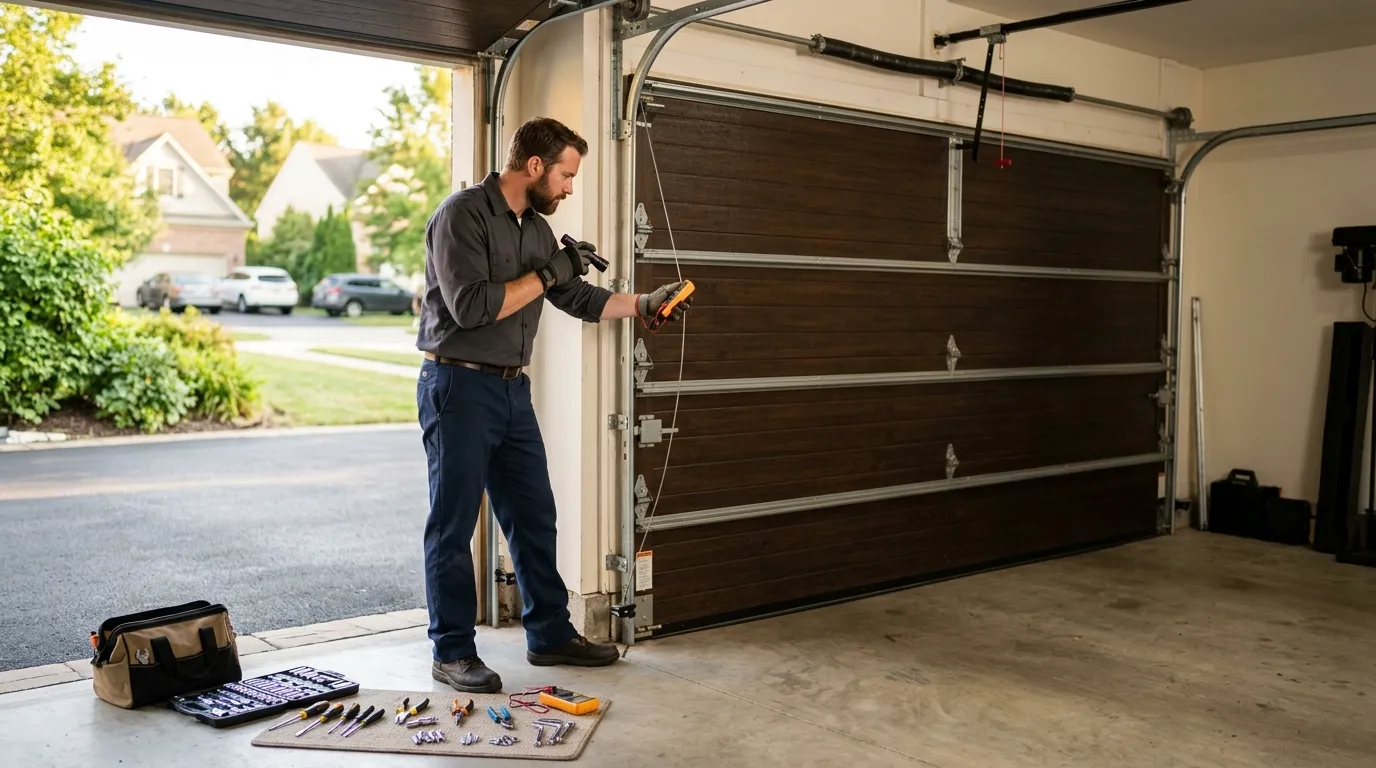
Pine Island is not the same job as the rest of the Rochester service area, and the doors prove it. Across the wider area the median home was built back in 1982, but Pine Island's housing mostly went up after 2001 - two decades newer. That gap matters more than it sounds. A 1982 house usually has a door that's been swapped once or twice already, with mismatched hardware from whoever fixed it last. A 2001-and-later Pine Island house is more likely still running its original builder-grade door and opener, on torsion springs that were sized for a new install, not upgraded since.
What that means on a call: less rot-and-replace on wood jambs, more "the spring finally gave out after twenty-some years of normal use." Openers here are more often chain or belt-drive units from the early 2000s to mid-2010s, which is a different repair than working on a decades-old chain drive with a worn sprocket. Sensor and circuit board faults show up more than full opener replacement. The cold-climate factor still applies across the board - this region sits in a severe cold band, and steel expands and contracts with every hard freeze-thaw cycle, which is hard on any door regardless of its age.
Pine Island isn't uniform. The center of town carries older construction mixed in among the newer stock that pushed the median build year to 2001, and the two don't need the same kind of visit. Older sections tend toward single-car garages and doors that have already had at least one hardware replacement - you can usually tell by mismatched brackets or a spring gauge that doesn't match the door weight. The newer subdivisions that built up after 2001 run wider two-car openings more often, with factory torsion setups that haven't needed touching yet.
We don't have a street-by-street map of which blocks are which - that's not something we track - but on a service call the build era tells us more than the address does. A homeowner in an older part of town is more likely calling about a track that's out of alignment after years of settling. A homeowner in a newer section is more likely calling because the spring that came with the house new is finally at the end of its life. Both are normal. Neither means the door was installed wrong.
Pine Island has around 1,427 households, a small fraction of the roughly 16,098 households spread across the full Rochester service area. Median household income here runs $91,612 - the same figure we see for the broader area, which tells you Pine Island isn't an outlier income-wise, just a smaller and newer pocket of it.
With most homes built from 2001 onward, attached two-car garages are the norm rather than the exception, and that's reflected in the doors we're called out to work on: wider sectional steel doors, factory torsion springs, and openers with photo-eye safety sensors that were required by code by the time these houses went up. Compare that to the 1947-2001 build range across the wider area, where you'll still find older single-door setups and side-mounted torsion hardware that nobody stocks new parts for anymore. Pine Island skews toward the newer end of that spectrum, which is a straightforward statement about what kind of parts we're likely bringing on the truck, not a claim about how well any individual door was built or maintained.
Given the build era, the calls we get from Pine Island lean a certain way. Torsion springs installed when these houses were new are now old enough - most sold as roughly 10,000-cycle units - to be reaching the end of their rated life, so spring replacement on doors from the early-to-mid 2000s is a regular job here, not an emergency so much as a predictable wear item finally showing up.
Opener issues tend toward circuit boards, remotes losing sync, and safety sensor misalignment rather than full unit swaps, since most of these openers are still within a reasonable service life. Cold-weather calls happen too - the severe cold band this region sits in means steel panels and seals take a beating every winter, and a door that binds or won't seal tight in January is a common complaint regardless of the house's age.
One honest limitation: if a spring or opener part is discontinued or takes a specialty order, we can't always get it same-week. For newer builder-grade doors that's rare, but it happens, and we'd rather tell a homeowner that up front than promise a timeline we can't hit.
Mostly in age and setup. Pine Island's housing is mostly newer, built from 2001 on, versus a median of 1982 across the wider service area. That means more factory torsion springs and modern openers, and fewer of the older side-mounted or single-door setups you'll find in the region's oldest housing stock.
Pine Island sits about 15 miles from Rochester. We travel out from there for service calls; there's no separate depot in Pine Island itself.
Not really. Torsion springs are rated by cycle count, usually around 10,000 cycles, not by calendar age. A door installed in 2001-2005 that's been used daily is right in the window where the original spring wears out, regardless of how new the house looks.
Yes. This region sits in a severe cold climate band, and steel doors and seals go through repeated freeze-thaw stress every winter. That shows up as binding tracks, stiff springs, and seals that no longer sit flush, independent of how old or new the door is.
Every service our crew runs in Pine Island, MN.
Call now or request a free quote - same-day service on most repairs, upfront written pricing.