Rochester, MN · Garage Door Service
Broken spring or dead opener in Rochester, MN? We work on doors from the 1947-2001 housing boom that fights our cold snaps every winter. Call now.
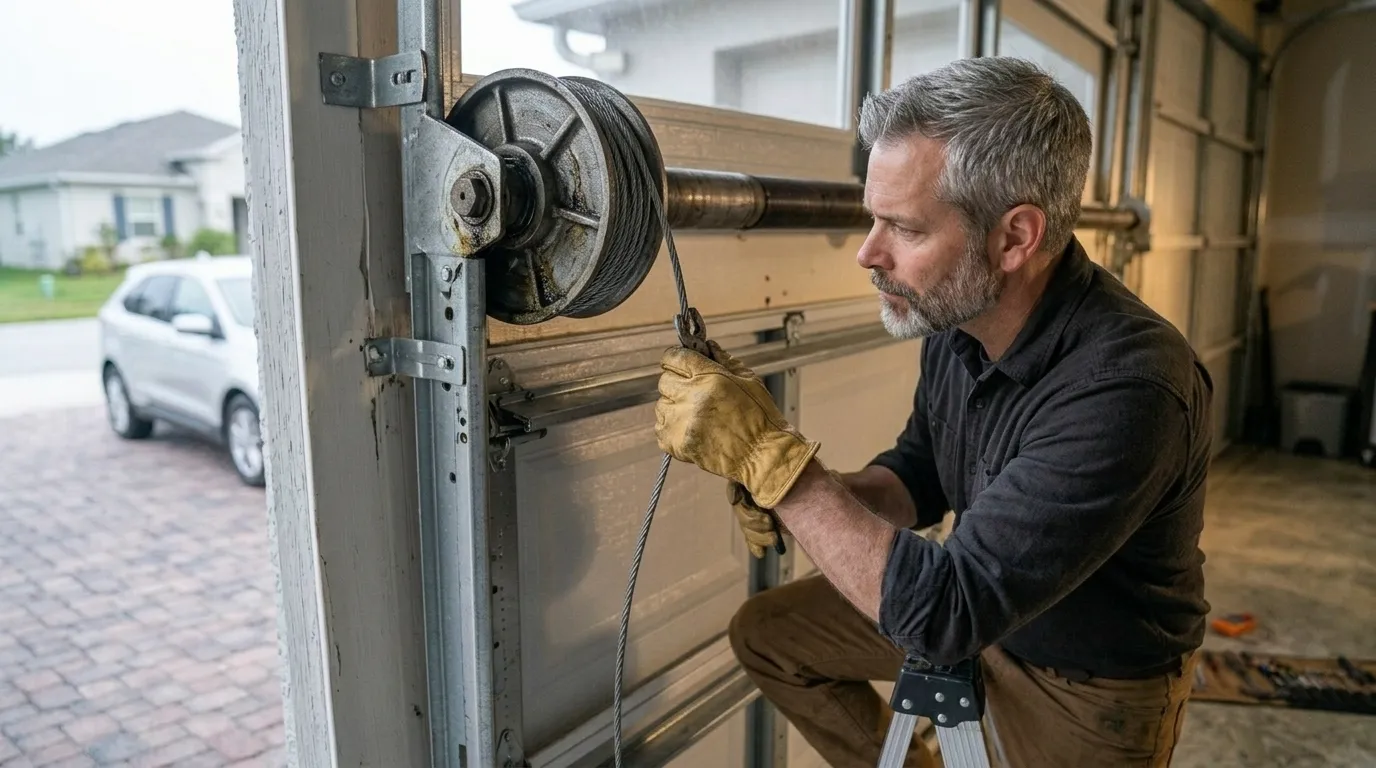
A garage door stuck halfway, a spring that snapped with a bang, or an opener that just clicks and goes nowhere - some of this you can look at safely, some of it you can't. If the door won't move and you can see a torsion spring split on the bar above the door, stop. That spring is under enough tension to break a finger or worse, and it's not a job for a homeowner with a ladder and a wrench. Same goes for cables that have frayed or jumped a drum.
What you can check yourself: the wall switch, the remote batteries, whether the safety sensors near the floor are aligned and clean (a knocked-over sensor is a common false alarm that reads like a dead opener), and whether the manual release cord is accidentally engaged. If the door runs on a track and one roller has jumped out of the channel, that's sometimes a call worth making before you touch it, since forcing a bent track back into place with the door still under spring load can make the repair bigger than it needs to be.
We'll say it plainly: if you're not sure what's under tension, don't guess. Springs and cables are the two things that send people to the ER, not the panels or the weatherstrip."
We're not going to throw out a number here that doesn't hold up once we're actually looking at your door. Cost on an emergency call depends on what broke, whether the opener or the spring system is original to the house, and whether parts are something we carry on the truck or something we have to source. A single broken spring on a standard double door is usually a different job than a burned-out opener motor or a bent track from a door that got hit.
What we can tell you is what drives the range: age and type of hardware matter a lot here, since a lot of homes across this area still have the torsion or extension spring setup that came with the house when it was built, not an upgraded version. Older setups sometimes need parts that aren't stocked everywhere, which can add a day if we don't have it on hand. We'll always tell you the number before we start work, not after."
The call we get most in the middle of a cold stretch is the same one: door won't budge, opener straining or clicking, and nine times out of ten it's a spring gone. Sometimes it's one spring on a double door that still tries to lift crooked before it gives up entirely. Sometimes it's the cable that finally snapped after fraying for months without anyone noticing.
A second common pattern is the opener that runs but the door doesn't move, or moves an inch and reverses. That's usually the drive gear stripped inside the unit, or a sensor knocked out of alignment by a stray hockey stick or a bike leaned against the frame.
Either way, the tell is timing: these calls cluster hard in the cold months. Metal contracts, grease stiffens, and a spring that was already fatigued from age finally lets go on the coldest morning of the week, not the mildest one."
Housing across this service area was mostly built between 1947 and 2001, with the bulk of it going up in the 1980s and 90s across the 17 named neighborhoods we cover. That matters for garage doors because a door and its hardware have a working life, and a lot of these houses are now old enough that their original spring systems, openers, or both are past due for failure, not just wear.
Layer on the climate. This area sits in a severe cold band, and steel springs and cables don't like big temperature swings. Cold makes metal brittle and lubricant thick, so a spring that's been slowly fatiguing for fifteen winters tends to pick the coldest morning to finally snap. We see the same pattern on doors from Byron to Stewartville to Kasson - houses of the same era, hit by the same winters, breaking the same way.
One honest limit: if your opener or spring system is original to a house built in the early part of that 1947-2001 window, sometimes replacement is the better call than another repair, since parts for the oldest units get harder to source every year. We'll tell you when that's the case instead of patching something that'll fail again next winter."
We take spring and opener failures as priority calls since a door that won't close is a security and cold-air problem, not just an inconvenience. Exact timing depends on where you are in the service area and what's already on the schedule, but we treat these as same-day when we can.
If the door is stuck open, or stuck shut and you need your car out, yes - treat it as one and don't try to force the door. If the door still closes but one spring looks frayed or uneven, it can usually wait a day or two, but don't ignore it since the second spring often follows.
Cold makes steel more brittle and stiffens the lubricant on springs and rollers, so a spring that's already fatigued from years of cycling tends to give out on the coldest days rather than the mild ones. It's a pattern we see clearly across this area's winters.
If the opener is original to a house from the older end of the 1947-2001 building range, parts can be harder to find, and replacement sometimes costs less over time than repeated patch repairs. We'll look at the specific unit and tell you honestly which side of that line it falls on.
By Neighborhood
We also handle emergency garage door in these Rochester-area suburbs.
Call now or request a free quote - same-day service on most repairs, upfront written pricing.