Rochester, MN · Garage Door Service
Stewartville homes date to 1987 - torsion springs, steel panel doors. We fix broken springs, cables and openers, dispatched from Rochester, 11 miles away.
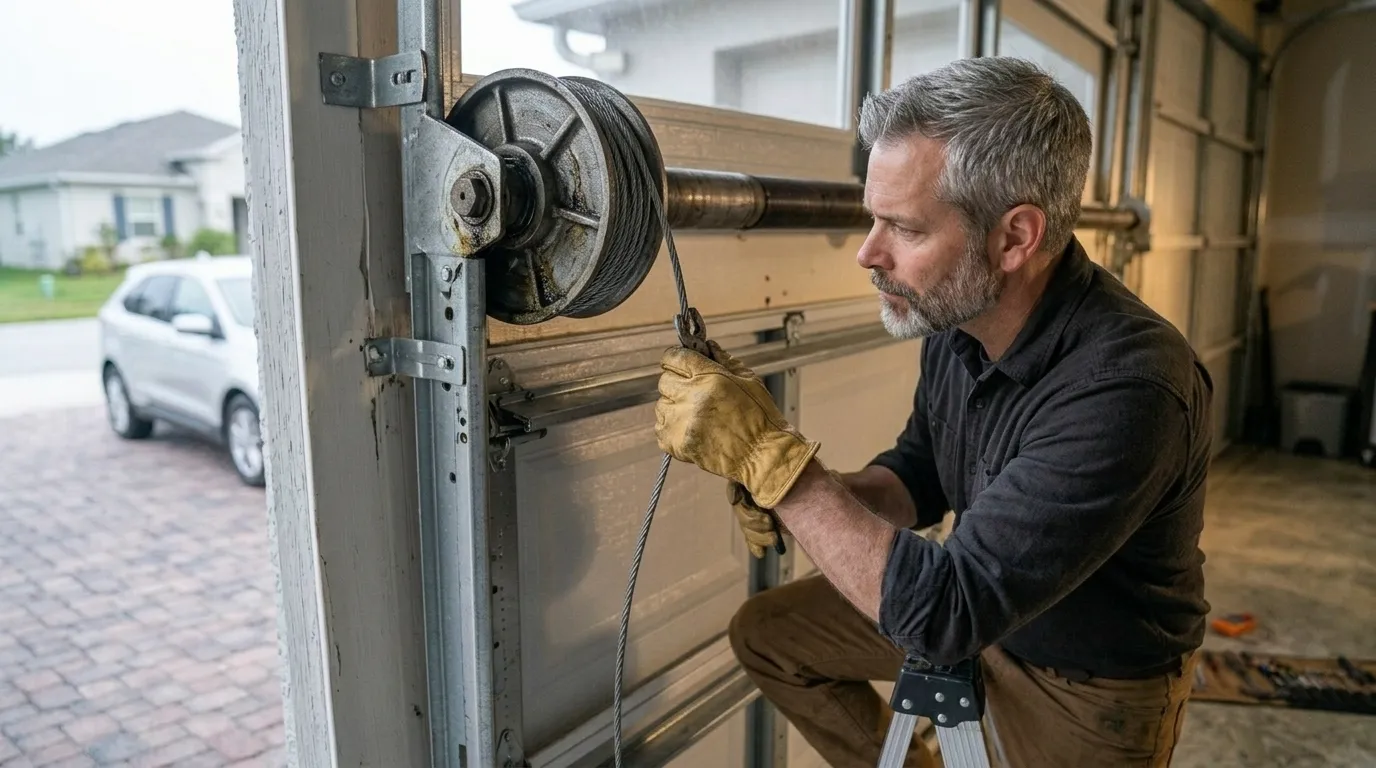
Stewartville's housing stock has a median build year of 1987, and that number tells us what's on the truck before we even leave Rochester. Doors from that era are almost always steel raised-panel with torsion springs mounted on a header above the opening, not the older extension-spring setups you'd find in a town with an earlier median build year. We carry torsion springs in the sizes that match 7-foot and 8-foot standard door heights, the cable and drum combinations that go with them, and nylon and steel rollers sized for the tracks that were standard through the late 1980s and 1990s. We also carry chain-drive opener parts, since a lot of openers installed in that window were chain, not belt. What we don't carry on every run is a spring wound for an oversized custom door - those get special-ordered, and we'll tell you that up front instead of pretending we can wing it. If your door is genuinely custom width or height, that's the one job where we may need a return trip.
A broken torsion spring is the most common emergency call, and the fix is mechanical, not electrical: we clamp the door, unwind the broken spring off the shaft, pull the old spring and center bracket, install a matched pair sized to the door's weight, and wind them to the correct number of turns for the drum size. On a 1987-era door that's usually a single 26-inch or 27-inch drum setup, standard for the panel weight common in this build era. If the cable snapped along with the spring - which happens more often than not, since a failing spring often takes the cable with it - we replace both cables at the same time rather than patching one side. Openers get checked separately: a door that won't open isn't always a spring, and a chain-drive unit from the 1990s with a stripped gear is a different repair than a dead spring, even though both show up to the homeowner as "the door won't move." We test travel limits and force settings before we leave, because a door that opens but slams on the way down is still a call-back waiting to happen.
Here's the honest limit: don't wind or unwind a torsion spring yourself. It's under enough tension to break a wrist or worse, and the winding bars and clamps that make it safe aren't things most garages have lying around. That's not a sales pitch, it's just true. What you can do yourself: check that the sensors at the bottom of the track are aligned and not blocked, listen for a specific noise (a loud bang usually means the spring, a grinding sound usually means the opener gear), and try the manual release cord to see if the door moves freely by hand - if it does, the opener may be the problem, not the spring. If the door won't budge even by hand, that's spring or track, and that's when to call. We'd rather talk you through what you're hearing over the phone than have you attempt a spring repair with borrowed bars.
A straightforward torsion spring replacement on a standard single or double door runs under two hours once we're on site, including the cable check and a full cycle test. Add an opener gear replacement or a full opener swap and you're looking at longer, since we're also reprogramming remotes and resetting travel limits. Older chain-drive units from the 1980s and 90s sometimes take extra time simply because the mounting hardware doesn't match what's sold today, and we have to adapt a bracket rather than bolt in a straight replacement. We don't quote a drive time to Stewartville itself - we run from Rochester, and traffic on any given day changes that more than distance does. What we can tell you is the job time on site, and that doesn't change based on which town we drove in from.
We don't have a set price to quote here without seeing the door, and giving you a number without that would be a guess dressed up as a fact. What we can tell you is what drives the cost: spring size and how many springs the door needs, whether the cable needs replacing alongside it, and whether the opener is original 1980s-90s hardware that needs an adapted bracket versus a straight modern swap. Stewartville's median household income runs lower than Rochester's own figure, and that's part of why we default to repairing a spring or cable rather than pushing a full door replacement when the panels and track are still sound. Replacement makes sense when the door itself is rusted through or the panels are dented past square - not just because a spring broke. If your door is failing on hardware that's original to a 1987 build, in most cases the fix is the spring and cable, not the whole door.
Cold is the recurring problem here. In severe cold, steel torsion springs lose some flex and can snap under load that they'd handle fine in warmer weather, which is part of why late fall and deep winter are when we get the most broken-spring calls. Nylon rollers get brittle in the cold and crack, and old grease in the track thickens up, which makes the opener strain against resistance it wasn't fighting in summer - that strain is what eventually burns out a gear or a capacitor. On a door that's original to the late 1980s, we sometimes find that a cable has been slowly fraying inside the drum for months before it finally lets go, which is why we check both cables any time we're already replacing a spring. The thing that goes wrong most is homeowners waiting on a slow-closing or noisy door until it fails completely in the cold, on a night when the fix takes longer because the metal itself has stiffened up.
Steel torsion springs lose some flexibility in severe cold and can snap under a load they'd normally handle without issue. This is common enough in winter that broken-spring calls increase noticeably during the coldest stretches. If your door is original to a 1980s or 90s build, the spring has also likely outlived its rated cycle count, which compounds the risk.
No. We run out of Rochester, about 11 miles from Stewartville, and dispatch from there for repair calls in town. We don't keep a branch location or fixed response time promise for Stewartville specifically, but the same truck and stocked parts that serve Rochester serve this run.
Depends on the failure. A stripped gear or worn drive component on a chain-drive unit from that era is usually repairable, though the mounting bracket sometimes needs adapting since hardware standards have shifted. If the circuit board itself is failing, replacement is usually more sensible than sourcing obsolete parts.
We'd advise against it. A wound torsion spring carries enough stored tension to cause serious injury without the right winding bars and clamps. It's one of the few jobs in this trade where the safety margin for DIY is genuinely thin, regardless of how mechanically confident you are.
Call now or request a free quote - same-day service on most repairs, upfront written pricing.